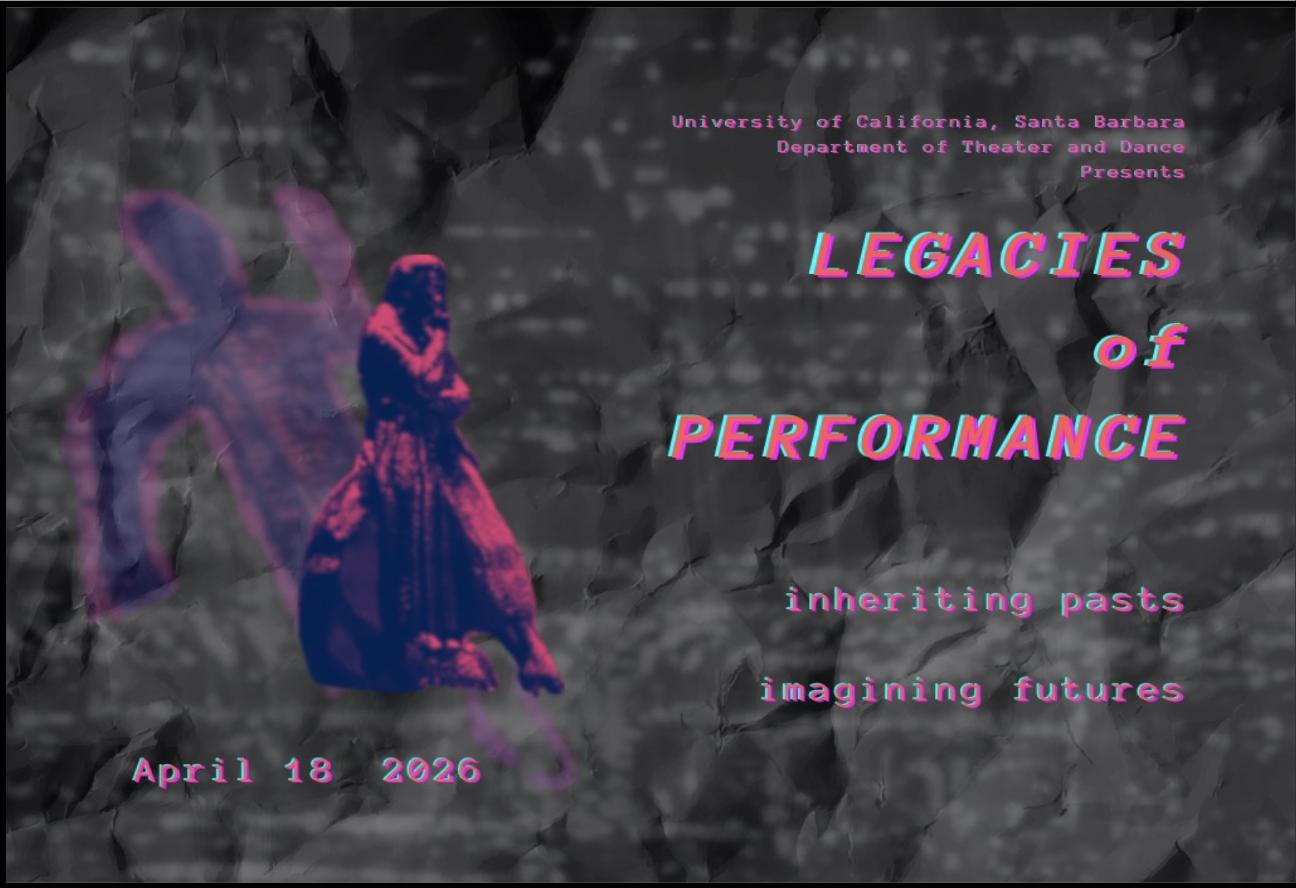
Legacies of Performance: Inheriting Pasts & Imagining Futures
Graduate Student Symposium
Sponsored by the Department of Theater and Dance
University of California, Santa Barbara
April 18, 2026
“Every image of the past that is not recognised by the present as one of its own threatens to disappear irretrievably.” – Walter Benjamin, 1942
“I have come to believe over and over again that what is most important to me must be spoken, made verbal and shared, even at the risk of having it bruised or misunderstood.” – Audre Lorde, 1978
The graduate students of the Department of Theater and Dance invite you to our renewed Graduate Student Symposium in beautiful Santa Barbara. This year, join us for discourse which explores inherited legacies of performance in higher education and how knowledge is produced in our field. We–scholars and artists–belong to a temporal genealogy of Performance Studies. Legacy, to us, generates questions of what past knowledge we recognize as essential for our present work, as well as what seeds of knowledge we are sowing in the creation of our own legacies. It is within this context that we find ourselves thinking about the past knowledge that is and has been claimed in the present and the threat of losing past knowledge that has not been recognized.
We welcome varied perspectives on “legacy,” and are especially interested in methods of investigation that use performance. Some questions we are interested in investigating include:
How are legacies created? How do legacies direct our studies? What necessitates working with or against legacies? And what are legacies that might have been forgotten? How do we rediscover these legacies and what does it mean to do so? What methods of knowledge production do we maintain? What marginalized perspectives or approaches do we bring to the forefront? What legacies do we recuperate, and which might we now leave behind?
The realms of the “imagined,” be it on page or stage, street or screen, is increasingly becoming conflicted as forms of articulations are canonized or censored, mobilized or mutated in terms of sectarian investments in the name of the nation, religion, and/or tradition. Our work can, and often must, operate within the legacies that have created these circumstances. Thus, it is our responsibility to consider how we can intervene, challenge, rewrite, or even disrupt these legacies. In the present moment, how do we as graduate students imagine the futures of our fields?
Possible areas for investigation include but are not limited to:
- Communal and cultural legacies
- Production of knowledge with communities (roots based production) vs. production of knowledge from communities of “the Other”
- Underrepresented epistemologies within the academy
- Temporal legacies
- Genealogies of Performance Studies
- Circular perspectives of time, cyclical genealogies / temporalities
- Futures of Performance Studies, technology, and AI
- From “reading legacies” to “rewriting legacies”
- Indeterminacy; “why us” and “why now” as crucial questions
- Political legacies
- Indigenous, Chicano, Black and AAPINH legacy & lineages (genealogy, temporality, migration, border crossing, positionality as graduate students in the present day, embodiment)
- Performance as activism
- Inheritance, property ownership, legacy admissions
- The state of the academy under authoritarianism / late-stage capitalism
- Creative Legacies
- Scholars of performance vs. in performance
- Knowledge produced through artistic and embodied processes and forms
- Creative practices included/excluded from the field of performance studies
- Legacies of design for performance: sonic, visual, lighting, technical
- Interpretive legacies
- Interrogating language in the discussion of legacy – “inherited legacies, ” “imagining futures,” “points of origin,” “disruption,” “rupture,” “intervention” “rediscover,” “rewrite”– what do/can these phrases mean?
- Ways of interpreting performances
- Performance as a model and method of critical reflection and analysis
- Performance as a meaning-making process
- How do our respective fields define legacies and performance, and are these definitions enough?
Suggested forms of submission:
- Individual Papers
- Lecture-demonstrations
- Practice-based workshops
- Performances
Submission Guidelines
20-minute Papers or Lecture-Demonstrations:
- Abstract (~250 words)
- Presenter biography for the conference program (100-150 words, third person)
Up to 60-minute Workshops and Performances:
-
Description (300-500 words): Please include a brief outline of the workshop/performance, how it engages with the theme, as well as the level/kind of interaction required from the audience (for workshops)/
-
Space and material needs
-
Abstract & Presenter biography for the conference program (100-150 words each, third person)
To submit your application, please fill out this google form, no later than Sunday, February 16, 2026 by 11.59 pm PT.
Submissions are limited to current graduate students.
Committee Co-Chairs
Cassie Archer - cassiearcher@ucsb.edu
Cate Greyjoy - ckg@ucsb.edu
Trevor Silverstein - trevorsilverstein@ucsb.edu
If you need to contact us, please include all co-chairs in your email. Thank you!